 |
|
 |
 |
 |
 |
 |
 |
 |
 |
 |
 |
 |
 |
 |
 |
The Different Supplications (Du'aa) of Namaaz |
|||||||||||||||
Rasoolullaah (SAWS) has said, ‘If a man sits on his prayer mat (masalla) folding his legs and remembers Allaah, he is blessed and glorious above all others. Allaah appoints an angel for him who will say in favour of that man, “Honour and good deeds will be extolled in your favour and sins will be erased from your record and Allaah will give supreme posts to you in the hereafter”. The angel keeps on saying to that man till he leaves his prayer mat.' Imaam Ja'far us-Saadiq (AS) has said, ‘Never omit supplications (du'aa) after the obligatory prayers because its merit is equal to the merit of obligatory prayer over the supererogatory prayers.' “The most excellent form of worship is supplication.” “The supplication after the mandatory prayer is better than the supererogatory prayer.” Imaam Ja'far us-Saadiq (AS) was questioned about two men who entered the mosque at the same time and offered the obligatory prayers. One of them said the supplications for longer time than the other and the other one recited the greater portion of Qur'an. Which of them was a meritorious act? Imaam (AS) replied that both the acts are meritorious and beautiful. He was then asked which of the act attracted more merit. Imaam (AS) replied that the supplication has greater merit because Allaah has said, “Pray to me and I will hear your prayer”. Rasoolullaah (SAWS) has said, “The man who offers supplication from the break of dawn to the time of sunrise will be more successful in his affairs than the one who journeys in the land as a merchant.” Rasoolullaah (SAWS) said to Ali (AS), ‘Recite Aayat ul-Kursi at the end of each prayer; no one but a prophet or a righteous person or a martyr can persevere in its recitation.' Maulaana Ali (AS) has said, “He who offers the fajr prayer and sits on his masalla and recites Surat ul-Ikhlaas 10 times before sunrise, will not commit any sin during the whole course of day despite influence of shaitaan . Maulaana Ali (AS) has said, “I heard Rasoolullaah (SAWS) saying, ‘He who recites Surat ul-Ikhlaas 100 times after the obligatory prayers, will cross the Seraat ul- Mustaqeem (the Bridge) on the Day of Qeyaamat. There will be eight cubits distance on the right and eight on the left. Maulaana Jibraeel will hold the man and the man will look down at the Fire of Hell on his both sides, and if he recognizes anyone there who has committed a sin short of polytheism, he will hold him by his hand and lead the sinner to the Paradise by his mediation.'” Allaah Ta'aala says in the Qur'an, “Remember me and I will remember you.” Whenever a man remembers Allaah while fulfilling his obedience, Allaah always remembers him with His mercy and approval, but many of us are not aware of it. People stand in the land of ignorance; they act without knowledge; they earn merit and demerit unknowingly, without understanding. But when they arrive in the life hereafter, they have arrived in the Life of Certainty where they possess knowledge, but cannot perform action because now it is too late for them. Rasoolullaah (SAWS), in one of his travels he came to a barren land, and he said to his companions, ‘Go and get firewood for us.' They said, ‘O Rasoolullaah (SAWS), we are on a barren land and there is no vegetation here!' Rasoolullaah (SAWS) said, ‘Move all of you to fetch whatever you get on your search.' Thus each one of them went about their way and brought one or two small pieces of firewood which were so light that even wind would carry them away, and by then a large heap of pieces of firewood gathered in front of Rasoolullaah (SAWS) and he said, “My intention was that this might serve as a lesson to you.” Good works are collected in such a way and sins accumulate in such a way in a heap. Surely, Allaah's mercy will come to him who looks to his conscience. |
|||||||||||||||
 |
|||||||||||||||
Recitation of Du'aa during Namaaz • After taking the niyyat of the obligatory prayer you should recite the following du'aa silently without saying ‘ Bismillah' at its beginning. After its recitation, you should begin the qeraat of the prayer. |
|||||||||||||||
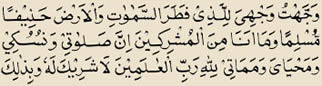
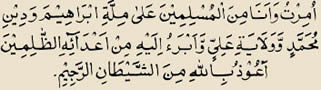
| Download “Wajjahto wajheya lillazee fataras samaawaate wal arza haneefam muslemaw wama ana minal mushrekeena inna salaati wa nosoki wa mahyaaya wa mamaati lillahe rabbil ‘aalameen. La shareeka lahu wabe zaaleka omirto wa ana minal muslemeen. ‘ Ala millate ibraheema wa deene mohammadiw wa walaayate ‘aliyyiw wa abra'o elaihe min a'daa'ehiz zaalemeen. A'oozo billahe minash shaitaanir rajeem.” “I have turned my face to Allaah, Who has created the sky (heavens) and the land. I am on the right path and I am a Muslim and I am not from the disbelievers (mushrik). Indeed my prayers, my sacrifices, my life, and my death are all dedicated to Allaah Who is the sustainer of all the universes, Who has no partner. I have been ordered to pray and I am among the true Muslims who are included in the community of Ibraaheem (AS) and religion of Mohammad (SAWS) and are determined in the love of Ali (AS) and who refrain from the enemies of Ali (AS); who are tyrants. I seek refuge before Allaah from the devil that is the most wicked.” |
|||||||||||||||
|
|||||||||||||||
• Tashahhud is also a part of the rak'at. It is of two types viz. small and big tashahhud . The small one is recited in all the four obligatory prayers of zohr, ‘asr, maghrib and ‘ishaa il-aakherat while sitting after the second prostration of the second rak'at. While in the obligatory prayer of fajr the big tashahhud is recited at the end of the second rak'at. The big tashahhud is recited at the end of the last rak'at of each faraz prayer and also at the end of every two rak'ats of sunnat and naafelat prayers. The tashahhud is recited after rising from the second prostration. You should say “Allaaho Akbar” while rising from the second prostration. The posture of sitting in the tashahhud is same as that of sitting between the two prostrations. The small tashahhud is given as follows:
| Download “Bismillaahe wa billaahe wal hamdo lillaahe wal 'asma ul husnaa kulloha lillaahe ash-hado an laa elaaha illallaaho wahdahu laa shareeka lahu wa ash-hado anna Mohammadan ‘abdohu wa rasoolohu. Allaahumma salle ‘ala Mohammadin nabiyeka wa taqabbal shafaa'atahu fi ummatehi wasalle ‘alayhe wa'ala ahle baytehit taahereen.” "I begin with the auspicious and bountiful name of Allaah and all praises are for Allaah and all the good attributes are only for Allaah. I bear witness that there is no God but Allaah, He is the one and has no partner and that Mohammad is His servant and messenger. O Allaah, send Your blessings upon Mohammad and accept his mediation (intercession) to forgive the sinners of his community on the Day of Judgement. Send blessings upon his descendants who are pure and pious. Allaah blesses all of them." After reciting the small tashahhud , you should proceed to the third rak'at of faraz prayer by rising up saying “Allaaho Akbar”. Attaining the same posture as discussed above, you should recite the big tashahhud after rising from the second prostration saying “Allaaho Akbar”. The big tashahhud is given as under:
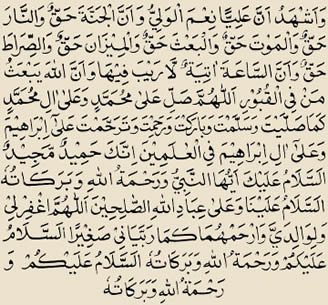
| Download “Attahiyaatut taiyebaato was salawaatut taaheraatuz zaakeyaatun naa'emaatus saabe'ghaatul ghaadeyaatur raa'ehaato lillaahe ma taaba wa khalosa wa tahora wa nama wa safa wa zaka lillaahe wama khabosa faleghairillaahe. Ash-hado an laa'elaaha illallaaho wahdahu la shareeka lahu wa ash-hado anna Mohammadan ‘abdohu wa rasoolohu. Arsalahu bil hodaa wa deenil haqqe basheeraw wa nazeera bayna yadayis saa'ate ash-hado annal laaha ne'mar rabbo wa ash-hado anna Mohammadan ne'mar rasoolo wa ash-hado anna ‘Aliyan ne'mal waliyo wa annal jannata haqqun wan naara haqqun wal mauta haqqun wal ba'sa haqqun wal meezana haqqun was seraata haqqun wa annas saa'ata aateyatul laa rayba feeha wa annallaaha yab'aso man fil qoboor. Allaahumma salle ‘ala Mohammadin wa ‘ala aale Mohammadin kama sallayta wa sallamta wa baarakta wa rahimta wa tarahhamta ‘ala Ibrahima wa ‘ala aale Ibrahima fil ‘aalameena innaka hameedum majeed. Assalaamo alayka ayyohan nabiyo wa rahmatullaahe wa barakaatohu. Assalaamo ‘alayna wa ‘ala ‘ebaadillaahis saaleheen. Allaahummagh firli walewaaledayya warhamhoma kama rabbayani sagheera." "All pleasant blessings and pure, good, clean, abundant, fragrant blessings are only for Allaah. Whatever is good, clean, pure, and virtuous is for Allaah and whatever is unclean, wicked and evil is attributed to other than Allaah. I bear witness that there is no God but Allaah who is One and has no partner. I bear witness that Mohammad is His servant and messenger with whom He has sent guidance and true religion; giving good tidings (messages) to believers and warning to the disbelievers of their fate on the Day of Judgement (Qeyaamat). In front of me, I bear witness that Allaah is wonderful Lord; that Mohammad is wonderful Messenger; that Ali is wonderful Saint, and that the paradise, hell, death, resurrection, scale of justice, and straight path are all realities; that the Day of Reckoning will undoubtedly come and that Allaah will raise the dead from their graves. O Allaah, send blessings upon Mohammad and his progeny just as you sent blessings, peace, bounty, kindness upon Ibraaheem and his progeny. Indeed you are kind and praiseworthy. Peace be upon you O Prophet and the blessings and bounty of Allaah upon you. Also peace be upon us and the virtuous followers of Allaah. O Allaah forgive me and my parents and treat them with the same kindness as they showed to me when they brought me up from my infancy." Imaam Ja'far as-Saadiq (AS) has said, ‘After you have completed your long tashahhud, send salutations (salaam to all sitting beside you), turning to your right and to your left.' You should say the following verses after completing the long tashahhud. First you should turn your head to right side then to the left saying the verse on both the sides. Saying these verses after the long tashahhud completes your prayer. “Assalaamo ‘alaykum wa rahmatullaahe wa barakaatohu.” Peace be upon you all and may Allaah bestow His blessings and bounty upon you. |
|||||||||||||||
|
|||||||||||||||
Recitation of Du'aa after Namaaz • Maulaana Ali (AS) has said, ‘If one rubs his face with his right hand after the completion of prayers and recites the following du'aa, Allaah will surely grant him all that he wishes.” You should first put your right hand on the prayer mat (masalla), and then with the same hand you should rub your face from the left cheek to the right, and then place the index finger on the forehead and kiss the finger. Refer to the figure. The du'aa is as follows:
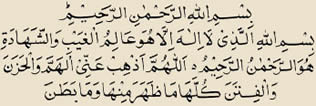
“Bismillaahil lazee la elaaha illa howa ‘aalemul ghaibe wash shahaadate howarrahmaanur raheem. Allaahumma azhib ‘anniyal hamma wal hazana wal fetana kullaha ma zahara minha wama batana.” "In the name of Allaah other than whom there is no God. He knows what is hidden and what is apparent. He is the most beneficent and merciful. O Allaah, remove from me all my sorrows and grief and save me from all the evils surrounding me whether hidden or apparent."
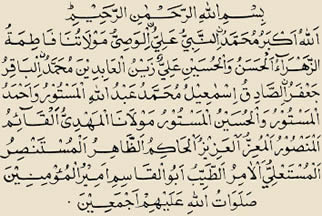
• The following du'aa is recited after every obligatory prayer except the obligatory prayer of ‘asr. This du'aa has the names of Khamsat ul-Athaar (AS), A'immat-e-Taahereen (AS) from the 3 rd Imaam Zayn ul-‘Aabideen (AS) to the 21 st Imaam Taiyeb (AS) and also contains the verses of blessings on them.
“Allaaho akbaro, Mohammadun nabiyo, Aliyul Wasiyo, Maulaatona Fatematuz zehraao, al Hasano, Wal Husain, Aliyo Zayn ul-‘Aabedin, Mohammadul Baaqero, Ja'far us-Saadeqo, Ismaa'ilo, Mohammado, Abdullaahil mastoor, wa Ahmadil mastoor, wal Husainil mastoor, maulanal Mahdiyo, Al Qaa'emo, Al Mansooro, Al Mo'izzo, Al ‘Azeezo, Al Haakemo, Az Zaahero, Al Mustansero, Al Musta'aliyo, Al Aamero, At Taiyebo abul Qaaseme ameerul mumeneen salawaatullaahe ‘alayhim ajma'een.” This is followed by the du'aa given below:
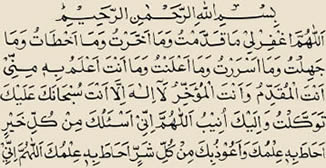
“Allaahummaghfirli ma qaddamto wama akhkharto wama akhtaato wama jahilto wama asrarto wama aa'lanto. Wama anta a'lamo behi minni antal muqaddemo wa antal mo'akhkhir. La elaaha illa anta subhaanaka ‘alayka tawakkalto wa elayka oneeb. Allaahumma inni as'aloka min kulle khairin ahaata behi ‘ilmoka wa a'oozo beka min kulle sharrin ahaata behi ‘ilmoka. Allaahumma inni as'alokal ‘aafeyata fi omoori kulleha wasta'eezo beka min khizyid dunyaa wa min ‘azaabil aakherate innaka ‘ala kulle shay'in qadeer.” "O Allaah, forgive my deeds; for which I have hurried or procrastinated (delayed); which are hidden or apparent since you know everything better than I do. You are the One Who advances or recedes the orders. I believe that there is no God but You. I depend upon You and turn towards You. O Allaah, I seek from You all the good that You are aware of and I seek distance from all the evil that You are aware of; under Your protection. O Allaah, bestow upon me; well being and success in all my affairs. I seek refuge before You from disgrace in this world and from the punishment in the hereafter. Indeed You have the power over everything."
• After reciting both the above du'aa, you should prostrate and recite the following verses in prostration:
“Sajada wajhee lillazee khalaqahu wa sawwarahu wa shaqqa sam'ahu wa basarahu. Allaahumma ya mo'izza kulle zaleelin salle ‘ala Mohammadiw wa ‘ala aale Mohammadin kama anta ahlohu wahum beka ahlohu salawaatoka ‘alayhim ajma'een.” "I lay my face in prostration to Allaah Who created it and shaped it so and gave ears to listen and eyes to see. O Allaah, the provider of honour to all the downtrodden (sufferers), send Your blessings upon Mohammad and his progeny just as Your recognition is from the recognition of his progeny (Ahl-e-Bayt (AS)) and their recognition from Yours'. Your blessings and peace be on all of them."
• Tasbeeh-e-Maulatana Fatema uz-Zahra (AS) Maulaana Ali (AS) has said, “Once upon a time, one of the foreign kings sent a slave to Rasoolullaah (SAWS). Maulatana Fatema (AS) was over burdened with the household work and was sick, so I told her to go to Rasoolullaah (SAWS) to ask for a servant. Rasoolullaah (SAWS) told her, “O Fatema (AS), I shall give you something better than that” and he told to Maulatana Fatema (AS) to recite the following tasbeeh after every obligatory prayer and he said that with the grace of Allaah your burden will be curtailed.
and lastly say,
Accordingly, Maulatana Fatema (AS) made this tasbeeh, a fixed practice for herself after every prayer and thus it was named after her.” Imaam Ja'far us-Saadiq (AS) has said, ‘One who recites the Tasbeeh-e-Fatema (AS) after the obligatory prayers, all his sins will be forgiven.' Rasoolullaah (SAWS) has said, “One who recites this tasbeeh, it brings a credit of 100 good works for him and one such good work brings credit for ten of its likes before Allaah. Thus he will obtain the credit of 1000 good works after each prayer and the credit of 5000 good works in the whole day. No one but an ignorant person would decline such a bounty from Allaah.”
• After completion of each prayer, you should step down from the right side of masalla and while folding the masalla you should recite the following du'aa:
“Allaahummaghfirli walewaaledayya waleman dakhala bayteya mumenan wa lil mumeneena wal mumenaate wala tazediz zaalemeena illa tabaara. Fa in tawallaw faqul hasbeyallaaho la elaaha illa howa ‘alayhe tawakkalto wa howa rabbul ‘arshil ‘azeem. Subhaana rabbeka rabbil ‘izzate ‘amma yasefoona wa salaamun ‘alal mursaleena wal hamdo lillaahe rabbil ‘aalameen.” "O Allaah, forgive me for my sins and forgive my parents, forgive the one who is the believer and he enters my home and forgive all the believer men and women; and don't do anything more to the tyrants but ruin them. O my prophet, don't grieve (become sad) if such people betray you and you say that Allaah will suffice for everything; there is no God but Allaah and I believe in Him; and He is the Lord of Supreme Throne. O Mohammad, magnificence is for your Lord Who is respectful and Who is not dependent on the praises of people. And peace be upon all the prophets and all the praises are due to Allaah Who is the sustainer of all universes." |
|||||||||||||||
Copyright
© 2016 Alavibohra.org All rights reserved.Vadodara. |
|||||||||||||||





 “Allaaho akbar” (Allaah is greatest) 33 times,
  “Alhamdo lillaah” (Praise be to Allaah) 33 times,
  “Subhaanallaah” (Glory be to Allaah) 33 times,
  “La ilaaha illallaah” (There is no God other than Allaah) once.

